

– FiberSystems
 In the News
  March 11, 2024
⚠️ Website Under Construction
In the News
March 11, 2024
– FiberSystems
 Insights
June 7, 2023
Insights
June 7, 2023
Surfing the internet is only possible thanks to data centres. Since the coronavirus pandemic, internet…
Surfing the internet is only possible thanks to data centres. Since the coronavirus pandemic, internet use has skyrocketed. In some countries a staggering download rate of 2.6 terabytes per second was reported after lockdowns were imposed. Researchers and companies are now looking for techniques to make data centres more energy-efficient.
All our online behaviour relies on those data centres, which can be described as large warehouses full of servers on which all kinds of online applications run. The physical layer of the internet consumes an enormous amount of energy. Exactly how much is not entirely clear, but it is expected that by 2030 it could take up as much as 20 per cent of our electricity consumption. The companies operating these facilities are racing against time to make their locations energy-efficient. With this aim, Microsoft recently tested an undersea data centre off the coast of the Scottish Orkney Islands.

Keep it cool
By far the largest data centre in Belgium can be found in Wallonia. At Saint-Ghislain in Hainaut, Google owns a complex that extends over 100 hectares. “We run almost all our applications from here,” says Site Operations Manager Frederic Descamps, “from Google Streetview and Maps to YouTube and of course the search engine itself.”
Much of the energy consumed by this Google data centre goes into cooling the servers. “We are lucky with the mild climate here,” said Descamps. “We can cool the servers using evaporation of water. This is done by letting water run past the servers. The water absorbs their heat and goes to a cooling tower, where it is sprayed into the air. The cooled water flows down the tower, so it can pass the servers again.”
This method turns out to be more efficient than the air cooling that data centres usually employ, which is comparable to an air conditioning system. Efficiency is measured using the so-called PUE ratio, short for power usage effectiveness. This is the ratio between the total energy consumption of a data centre and the energy needed to power the servers. “That ratio must be kept as low as possible,” says Descamps. “You want to use as little energy as possible on top of what is specifically needed for the servers.” In Saint-Ghislain, Google achieves an annual PUE average of 1.08, according to Descamps. That is pretty good efficiency: market research firm Uptime Institute found the average PUE worldwide in 2020 was 1.58.

Bigger is better
The oversized facility in Saint-Ghislain is one of the so-called hyperscale data centres. “These server complexes use more than 50 megawatts of power,” says Marc Decorte of data centre builder Kevlinx, “whilst most data centres in Belgium offer less than 10 megawatts of capacity.”
In Brussels, Kevlinx is working on the development of a new hyperscale location on behalf of the British telecoms company COLT. This future data centre in Brussels will consume up to 68 megawatts – equivalent to the consumption of tens of thousands of households.
And yet, such hyperscale centres are often positive evolutions. Large data centres replace smaller versions or server rooms at the companies themselves. These larger locations are often more efficient, and invest more in cooling technology and newer servers. Kevlinx is now aiming for a PUE of less than 1.2 for this site. In addition, it is investigating how residual heat can be used for heating the surrounding offices, to reduce consumption of fossil fuels even further.
Training AI to save energy
Being energy-efficient is not only about cooling: it is also about the efficiency of the servers themselves and the applications that run on them. For a number of years, many of their functions have been based on artificial intelligence. Applications using AI, like YouTube and Google Translate, require a lot of calculations from computers and therefore consume tonnes of energy.
Usually, an AI system is trained by serving it large amounts of data. It then autonomously discovers patterns and learns to take actions based on them. “An AI system in a self-driving car, for example, gets a lot of video images on which pedestrians are already indicated,” says AI expert Mieke De Ketelaere of imec. “The system learns to recognise them on new images and to avoid them once the car is on the road.”
A new training method eliminates certain calculations if they are not important. This process, called network pruning, saves energy, but how much depends on the AI model and the hardware used during the training process.
Photonics as an energy saver
If investments continue to be made, consumption could remain flat until 2022. However, there are other areas where data centres can save energy. The Dutch company EFFECT Photonics makes another link more efficient: the connection between the data centre and the internet. Data is sent back and forth via fibre-optic cables – ‘travelling’ in the form of optical signals. But data centres themselves only work via electrical signals.
“We design the parts that convert electrical data into optical pulses,” explains Boudewijn Docter, President of EFFECT Photonics. The company enables systems to work more energy-efficiently than before. “With previous systems you had a lot of separate parts, but we now place everything on one chip. This way the transition performs better.”
It means you can get the same amount of bits per second through the fibre-optic cable, but with the advantage of a highly reduced energy consumption. Reducing emissions is after all a major concern. Recent predictions state that the energy consumption of data centres is set to account for 3.2 percent of the total worldwide carbon emissions by 2025 and they could consume no less than a fifth of global electricity. By 2040, storing digital data is set to create 14 percent of the world’s emissions, around the same proportion as the US does today (source: Computerworld). It is here where EFFECT Photonics sees making a significant contribution. Their System on Chip technology provide the desired high-speed, but also the necessary energy efficiency. Their photonic integrated circuits for transceivers enable these mega-datacentres to reduce their impact on society. In this increasingly data-driven economy, datacentres remain one of the most important pieces of our business infrastructure, so they will have to adopt this technology.

Servers go under… water?
Meanwhile, new trends are also emerging. Artificial intelligence, for example, helps to adjust the cooling very precisely according to the temperatures in a data centre. Since 2018, a number of Google data centres have been making full use of AI systems to achieve this.
A data centre must be able to guarantee customers that it will always remain online. To be on the safe side, (environmentally harmful) diesel generators are therefore on standby. Companies are now replacing those generators with hydrogen fuel cells. Microsoft has already conducted tests with this in 2020.
In the future, we may store computer parts or even entire servers in liquids. “Liquid can conduct heat better,” says Marc Decorte. “This ensures that less heat is lost compared to air cooling or water cooling. Such technology is coming in the near future.”
Technological innovations can slow down the acceleration of our energy consumption. In the past few decades our data usage has increased exponentially, but the growth in associated energy consumption has been much slower. Expectations are that data centre energy consumption could remain flat at least until 2022.
“Data centres are getting bigger,” says Ronnie Belmans (EnergyVille, KU Leuven). “Perhaps Google’s site in Saint-Ghislain will consume more energy in the near future than the entire Antwerp site of the chemical company BASF, which is a milestone.”
He adds that there used to be 30 power plants in Belgium, but the trend is toward decentralisation: “Hundreds of thousands of small energy installations will soon be connected to the grid. The solar panels on your roof will provide energy to your neighbours. We can only coordinate all this with a highly developed IT infrastructure. In any case, we need data centres for that.”
The above solutions will help in minimising the energy consumption of data centres, but our internet usage will undoubtedly continue to grow. Advanced cooling, AI, storage in liquids, and photonics will help us tame these big – but very necessary – energy beasts.
Article Source: https://www.eoswetenschap.eu/technologie/hoe-maken-we-datacenters-tegelijk-groter-en-zuiniger
Tags: AI, DataCenter, EFFECT Photonics, Energy, Google Ghislain, Green Energy, imec, Leuven, Microsoft undersea Data Center, Optical Chips, Telecom Insights
March 22, 2023
Insights
March 22, 2023
Artificial intelligence (AI) will have a significant role in making optical networks more scalable, affordable,…
Artificial intelligence (AI) will have a significant role in making optical networks more scalable, affordable, and sustainable. It can gather information from devices across the optical network to identify patterns and make decisions independently without human input. By synergizing with other technologies, such as network function virtualization (NFV), AI can become a centralized management and orchestration network layer. Such a setup can fully automate network provisioning, diagnostics, and management, as shown in the diagram below.
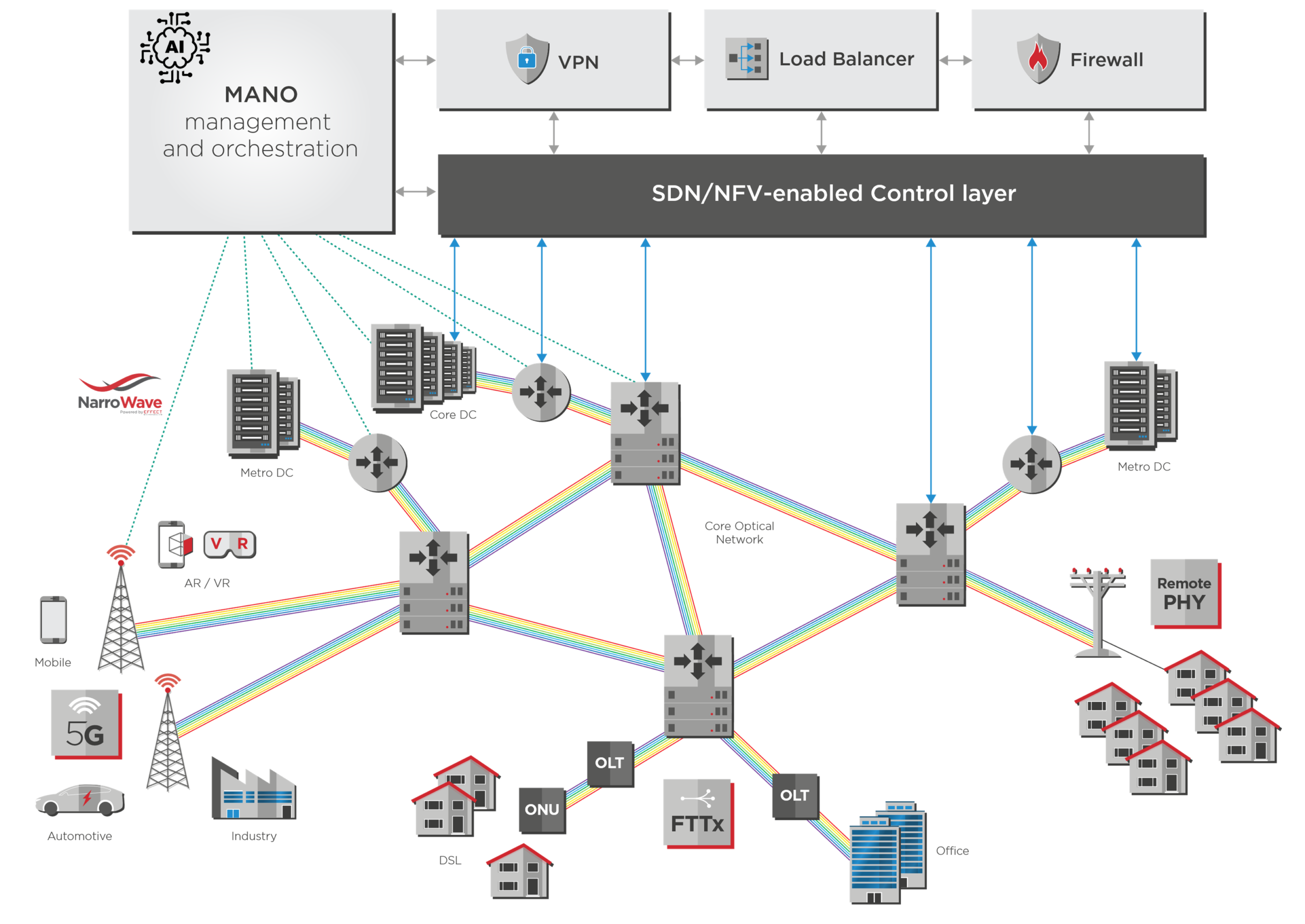
However, artificial intelligence and machine learning algorithms are data-hungry. To work optimally, they need information from all network layers and ever-faster data centers to process it quickly. Pluggable optical transceivers thus need to become smarter, relaying more information back to the AI central unit, and faster, enabling increased AI processing.
Optical transceivers are crucial in developing better AI systems by facilitating the rapid, reliable data transmission these systems need to do their jobs. High-speed, high-bandwidth connections are essential to interconnect data centers and supercomputers that host AI systems and allow them to analyze a massive volume of data.
In addition, optical transceivers are essential for facilitating the development of artificial intelligence-based edge computing, which entails relocating compute resources to the network’s periphery. This is essential for facilitating the quick processing of data from Internet-of-Things (IoT) devices like sensors and cameras, which helps minimize latency and increase reaction times.
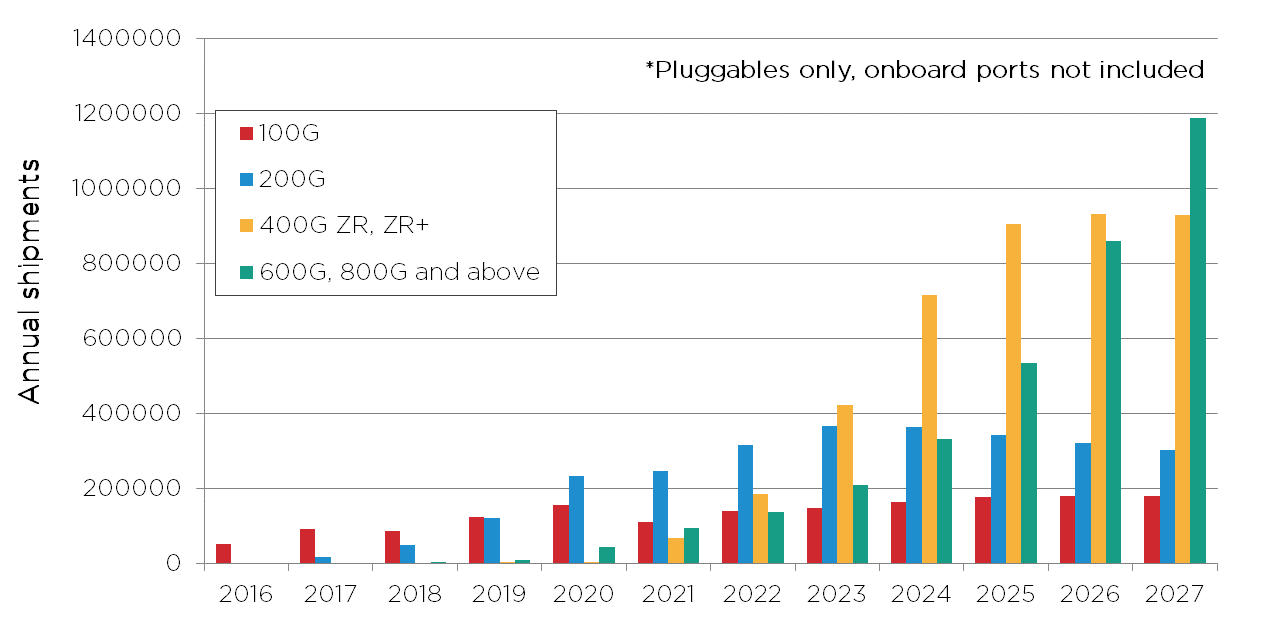
400 Gbps links are becoming the standard across data center interconnects, but providers are already considering the next steps. LightCounting forecasts significant growth in the shipments of dense-wavelength division multiplexing (DWDM) ports with data rates of 600G, 800G, and beyond in the next five years. We discuss these solutions in greater detail in our article about the roadmap to 800G and beyond.
Mobile networks now and in the future will consist of a massive number of devices, software applications, and technologies. Self-managed, zero-touch automated networks will be required to handle all these new devices and use cases. Realizing this full network automation requires two vital components.
These goals require smart optical equipment and components that provide comprehensive telemetry data about their status and the fiber they are connected to. The AI-controlled centralized management and orchestration layer can then use this data for remote management and diagnostics. We discuss this topic further in our previous article on remote provisioning, diagnostics, and management.
For example, a smart optical transceiver that fits this centralized AI-management model should relay data to the AI controller about fiber conditions. Such monitoring is not just limited to finding major faults or cuts in the fiber but also smaller degradations or delays in the fiber that stem from age, increased stress in the link due to increased traffic, and nonlinear optical effects. A transceiver that could relay all this data allows the AI controller to make better decisions about how to route traffic through the network.
After relaying data to the AI management system, a smart pluggable transceiver must also switch parameters to adapt to different use cases and instructions given by the controller.
Let’s look at an example of forward error correction (FEC). FEC makes the coherent link much more tolerant to noise than a direct detect system and enables much longer reach and higher capacity. In other words, FEC algorithms allow the DSP to enhance the link performance without changing the hardware. This enhancement is analogous to imaging cameras: image processing algorithms allow the lenses inside your phone camera to produce a higher-quality image.
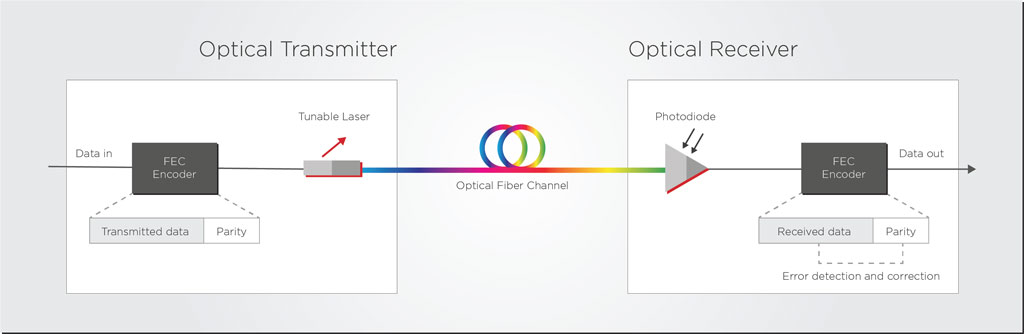
A smart transceiver and DSP could switch among different FEC algorithms to adapt to network performance and use cases. Let’s look at the case of upgrading a long metro link of 650km running at 100 Gbps with open FEC. The operator needs to increase that link capacity to 400 Gbps, but open FEC could struggle to provide the necessary link performance. However, if the transceiver can be remotely reconfigured to use a proprietary FEC standard, the transceiver will be able to handle this upgraded link.
Reconfigurable transceivers can also be beneficial to auto-configure links to deal with specific network conditions, especially in brownfield links. Let’s return to the fiber monitoring subject we discussed in the previous section. A transceiver can change its modulation scheme or lower the power of its semiconductor optical amplifier (SOA) if telemetry data indicates a good quality fiber. Conversely, if the fiber quality is poor, the transceiver can transmit with a more limited modulation scheme or higher power to reduce bit errors. If the smart pluggable detects that the fiber length is relatively short, the laser transmitter power or the DSP power consumption could be scaled down to save energy.
Optical networks will need artificial intelligence and machine learning to scale more efficiently and affordably to handle the increased traffic and connected devices. Conversely, AI systems will also need faster pluggables than before to acquire data and make decisions more quickly. Pluggables that fit this new AI era must be fast, smart, and adapt to multiple use cases and conditions. They will need to scale up to speeds beyond 400G and relay monitoring data back to the AI management layer in the central office. The AI management layer can then program transceiver interfaces from this telemetry data to change parameters and optimize the network.
Tags: 800G, 800G and beyond, adaptation, affordable, AI, artificial intelligence, automation, CloudComputing, data, DataCenter, EFFECT Photonics, FEC, fiber quality, innovation, integration, laser arrays, machine learning, network conditions, network optimization, Networking, optical transceivers, photonic integration, Photonics, physical layer, programmable interface, scalable, sensor data flow, technology, Telecommunications, telemetry data, terabyte, upgrade, virtualization© 2026 EFFECT PHOTONICS All rights reserved. T&C of Website - T&C of Purchase - Privacy Policy - Cookie Policy - Supplier Code of Conduct